
Veröffentlicht am 28/10/2026 11:01:14
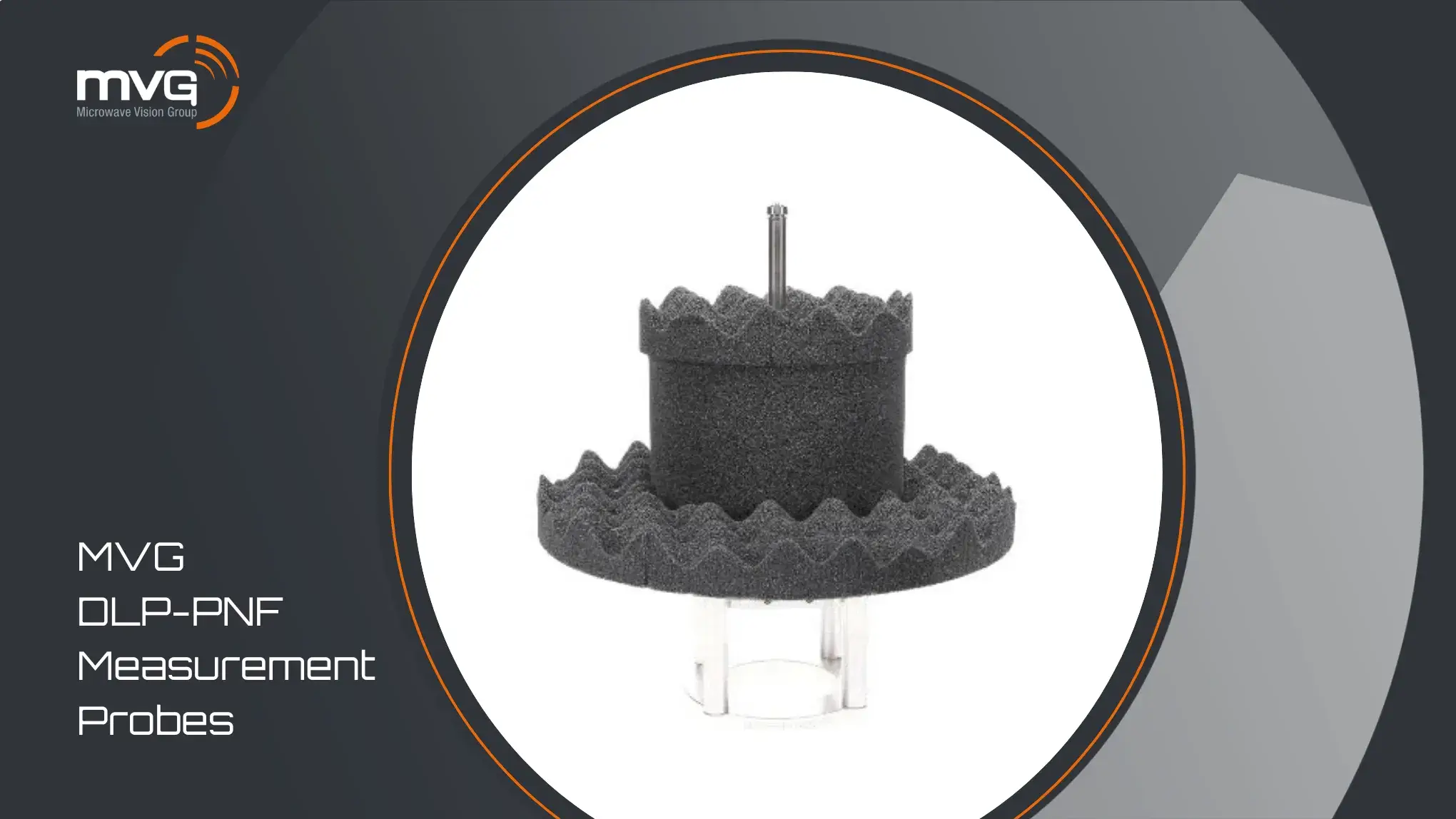
Short probe-to-antenna-under-test (AUT) distances can make probe interaction a limiting factor in planar near-field (PNF) measurement accuracy. The MVG DLP-PNF series is designed specifically to minimize scattering in these configurations.
Its full-octave design uses an electrically small and axially symmetric aperture providing near-constant directivity across the bandwidth and very low cross-polarization. A balanced orthomode junction (OMJ) with external feed circuitry supports high polarization purity.
Across the series, the DLP-PNF probes cover 0.8 to 75 GHz. While the probe architecture and aperture design ensure high accuracy and minimal scattering, test efficiency is driven by dual-polarization and bandwidth. An optional switch enables characterization of both polarizations in a single scan, while the full-octave bandwidth per probe significantly reduces the number of probe changes required across a given test campaign.
Learn more about the specific design and measurement characteristics of the DLP-PNF 650 model in the MVG technical paper
Key Technical Advantages
Applicable in measurements of high-gain directional antennas and phased arrays, the DLP-PNF brings several key technical advantages to the measurement scenario:
• Dual linear polarization with high on-axis polarization purity and isolation
• No nulls in the forward radiation pattern
• Low back-scattering
• Wideband, low dispersion
Get the specifications on the DLP-PNF probes from the updated datasheet: